Where can we find a little more humanity?
This material was written by www.offnews.bg staff and was published from here without changes.
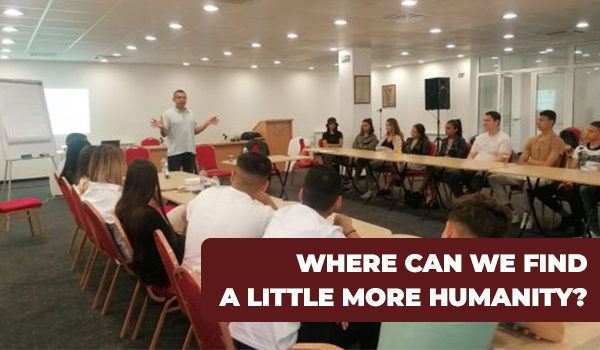
A workshop with children, adolescents, school principals, teachers, local government employees, educational mediators, and representatives of the social services
Humanity deficiencies are a key challenge for the systems working with children who have become witnesses, victims, or perpetrators of a crime. Respect for the individual, the dignity of the child, and responsibility for the protection of its rights and interests need to be the main principle in the work of the juvenile justice system. This applies to all of the social and educational support measures, aimed at children, who, in some way or another, have become a part of the complicated, and many times victimizing, legal procedures of the adults. But does Bulgaria manage to solve these challenges adequately?
Bulgaria claims that the two EU directives from 2012 and 2016, pertaining to the protection of the rights and interests of the children who have found themselves in contact with the justice system, have been transposed successfully. However, BCNL’s study insists that copying and inserting outside texts in national legal acts is not enough for successful transposition. A transposition is successful only when we successfully restructure the systems’ work so that they fully pursue the objectives of European legislation. In the juvenile justice system - to move on from the dominating paternalistic model, which treats the child as a silent object subjected to an outside influence, to an approach that protects a child’s dignity and aims at its best interests. Regardless of the declarations for judicial reforms and multiple isolated legislative changes, the individual assessment is not widely introduced, the blue rooms are not developed or used as an instrument when working with children, and the administrative culture and the institutional practices have not changed in a manner of keeping with the spirit and objectives of the two EU directives for child-friendly justice. As a result, many times, the right to information is replaced by intimidation, the psychologists from the blue rooms are reduced to message retranslators, and the right to be assisted by a lawyer is being realized too late: many times, just before entering a courtroom, and the lack of well-developed social support services system turns the police departments and the investigative detention into orphanages.
The institutions involved in child-friendly justice are well aware of these issues. The problem is that usually the bad results are addressed with over-formalization of the procedures. And this, in turn, causes three very negative outcomes:
- It significantly limits the operational field of the experts from law enforcement, education, the social, the court, and other systems.
- It shifts the focus from the child’s interests to the paperwork.
- It replaces the crucial question about the philosophy and the principles of working with children in contact with the law through administrative and organizational palliative measures that are pejorative to the children. As a result, instead of the professionals having a special approach towards each child, the children are again drifted to the periphery, and the systems do not work for helping their interests, but rather about their interests.
Our society is an object of multiple hybrid attacks through fake news, common opinions about “reasons” and “value systems” that contradict democracy, rule of law, separation of powers, respect for dignity, and individual and the political civil freedoms, which does not create a favorable social environment, which can lighten the transition from the paternalism and sweetness paradigm to thinking through rights and best interests in the juvenile justice system. The social tension about the so-called Istanbul Convention, the Social Services Act, the Disabled People Act, and many more, is a clear indicator that not only children are in contact with the justice system, but all vulnerable groups become victims of the discriminative, racist, and nationalist public perceptions spread.
This, together with the lack of institutional culture, established procedures, and good practices for inter-institutional cooperation, favors the imposition of the view that “nothing works out here,” “the criminals are criminals,” and “they cannot change even though they are still children,” and the only rescue will be “if they are caught abroad, where there are trained experts and real social services.”
From the institutional point of view of the adults, it seems that we are at a dead-end, so representatives of the BCNL team asked the children themselves about their opinion on this topic. At the end of May, with the assistance of the association LARGO, a workshop with children, adolescents, school principals, teachers, local government employees, educational mediators, and representatives of the social services was conducted in Kyustendil. Discussions confirmed the hypothesis that discrimination and negative attitudes do not generate working solutions; on the contrary, they destroy the few bridges for cooperation between institutions for better results. Apart from that, it is more efficient to work on prevention, rather than trying to overcome the consequences of escalated conflicts and tensions. On the same note, coordination between the education, social, and law enforcement systems is key, and the intervening role of the educational mediators is proven and guarantees excellent results because they are recognizable and have authority, both within the local communities and the public institutions. But the institutions get to enjoy public support, and the systems work when and only when the institutions are effective. If there were a breakthrough, however, what would easily accommodate are the “customs,” “traditions,” “personal connections,” and many other social regulators, which, together with the poverty and the crises of the families and the communities, are a precondition for abuse of vulnerable children, who easily become victims of human trafficking, prostitution, drugs, pornography, blackmailing, etc.
If the “traditional” public mindset changes so slowly and difficult, wouldn’t there be any promising moves in the short term that can help the humanization of the Bulgarian juvenile justice system? The BCNL team suggests work in at least two main directions:
A. Most often, the reasons for children to be in a situation of conflict with the law are social and/or economic. Poverty is still a significant risk for many children in Bulgaria. Right now, society punishes children because their parents are poor, have gone abroad, neglect their children, are divorced, and do not manage to deal with their social problems. Okay, but social problems require social service rather than repression. That’s why it is important to build an efficient social infrastructure, consisting of enough and available specialized services, with trained professionals to work at school, the community, court, etc.
B. If professionals (judges, prosecutors, lawyers, police officers, social services, children pedagogical rooms inspectors, schools, etc.) work in coordination, meaning to discuss the cases together and follow one general plan, they would manage to achieve better results here and now, including quickly solving cases, and preventing further escalation of the problems in the name of protection of the interests of the child and the community. Not always complicated legislative changes are needed. Sometimes, problems can be solved with a little more humanity.
